
0 minute read
Wake and Scrape, How to Use a Tongue Scraper
Please consider ‘Wake and Scrape’ our new personal mantra. The ancient Ayurvedic practice of tongue cleaning is now firmly in the mainstream.
HOW I ENDED UP WITH ONE
Recently, as I was frolicking amongst the perfectly curated and dimly lit shelves of my favourite local natural skincare and wellness dealer, I came across something rather peculiar.
Presenting conspicuously as an Victorian-style dentistry tool (and not overly dissimilar to a medieval torture device) – this thin copper curl of metal piqued my interest immediately, and I waved over the store owner to pour me a warm cup of demystification.
“That’s a tongue scraper,” they said. “It will change your life.”
Six minutes later, I was the owner of one; schlepping happily towards an enlightened world of oral hygiene steeped in ancient Ayurvedic practices. Before I leaned fully into my enlightened new existence, though, I wanted to know what I had actually bought, and whether any of the promises held up. Here is everything I learned, including the parts nobody warns you about.
WHAT IS TONGUE SCRAPING?
Tongue scraping means drawing a firm curved tool across the surface of your tongue to lift away the coating that gathers there. That coating is a mix of bacteria, food particles and dead cells, and it builds up most while you sleep, which is why your tongue looks its worst in the morning.
A toothbrush is not particularly good at this. Its bristles are made to clean the smooth hard surfaces of teeth, and on a soft grooved tongue they mostly push things around. A scraper lifts the coating off instead.
WHAT TONGUE SCRAPING ACTUALLY DOES
I went looking for the benefits, and as a precautionary tale, I recommend avoiding the image results if you fancy holding on to your breakfast.
A better sense of taste. This is the benefit with the most research behind it. Removing the coating gives your taste buds clearer access to what you are eating, and studies suggest you can notice a difference within about two weeks. Bitter, sweet, salty and sour all arrive with a little more definition. Fancy.
Fresher breath. Tongue coating is one of the most common sources of bad breath. Scraping removes a good deal of the bacteria responsible, which is why many people notice their mouth stays fresher through the morning.
A cleaner looking tongue. That white or pale coating you see in the mirror is exactly what the scraper takes away.
A supporting role in oral health. Tongue scraping is a useful part of a routine, not a replacement for brushing and flossing. Think of it as the step that finishes the job rather than the one that does it.
AN ANCIENT PRACTICE, NOT A NEW TREND
It turns out tongue scraping is an Ayurvedic practice from traditional Indian medicine, and a centuries-old ritual across parts of Europe, Africa, Arabia and South America. In Ayurveda the tongue is read as an indication of the body's wider state, capable of revealing inflammation or pain elsewhere.
The eyes may be a window to the soul, but the tongue is the heart of your health.
Side note: I introduced a daily gua sha massage into my routine a few years ago and completely failed to recognise it as an ancient Chinese ritual. I would like to do better this time.
HOW TO USE A TONGUE SCRAPER
1. Do it in the morning, before you eat or drink. This is when the coating is heaviest.
2. Stick out your tongue and relax. Hold the scraper with the curve facing down.
3. Start as far back as is comfortable. I went straight to the very back of my tongue, my gag reflex arrived immediately, and I nearly lost the morning. You might want to start further forward until you feel comfortable starting from the back of the tongue.
4. Draw it slowly forward using gentle, even pressure. It should never hurt.
5. Rinse and repeat five to ten times, until nothing more comes away.
6. Then brush and floss as usual, and rinse your mouth with water.
The whole thing takes under a minute, which is less time than it took you to read this section.
METAL, COPPER OR PLASTIC?
Scrapers come in all three, and the material matters more than you might expect.
Plastic is cheap and flexes too much to lift the coating properly. It also wears down and needs replacing often.
Copper is traditional in Ayurveda and much loved for it, though it tarnishes and asks for more upkeep.
Stainless steel is what Youtime stock and what I use. It stays hygienic, it doesn't hold onto bacteria, and it will still be in your bathroom in ten years time.
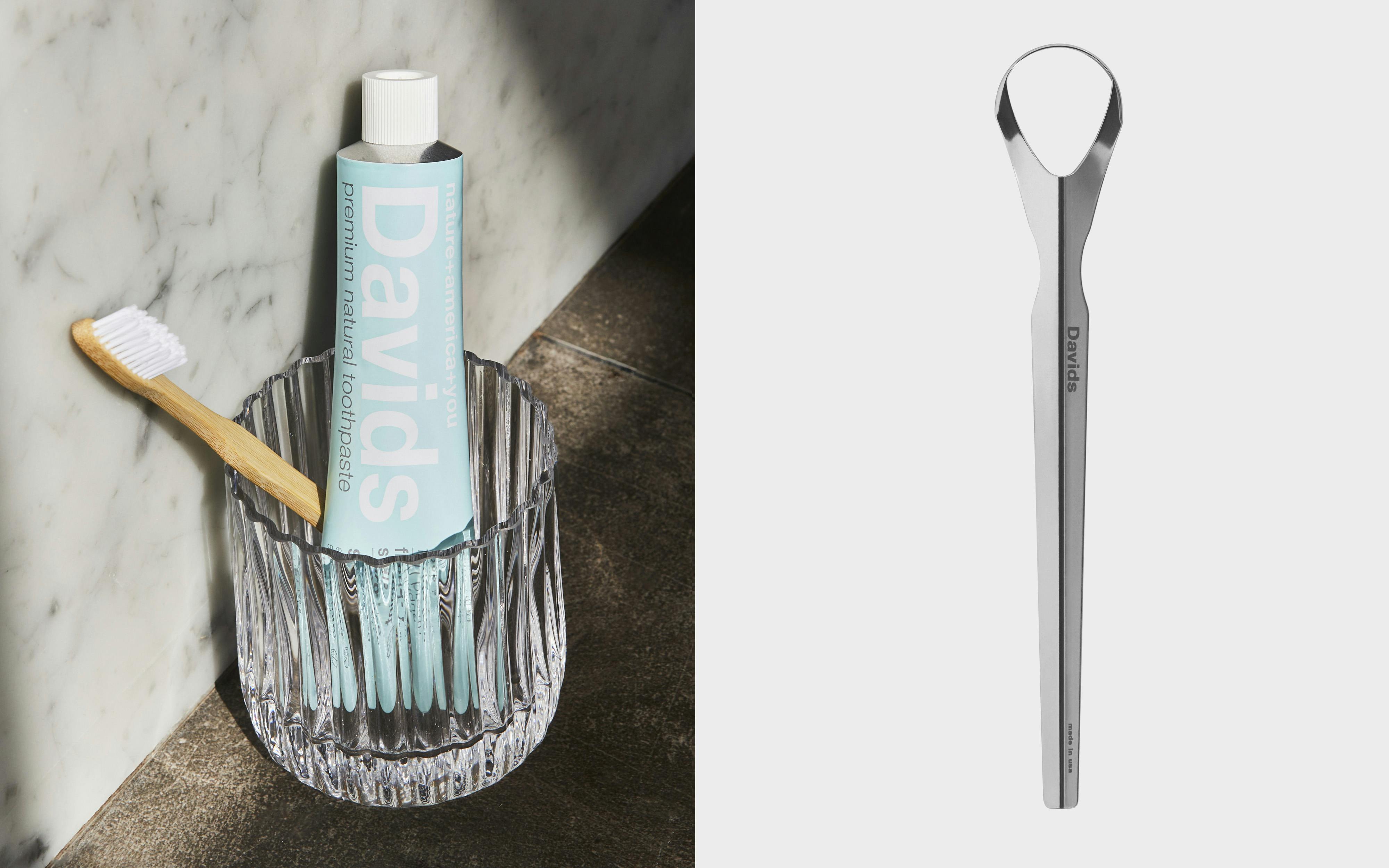
Ours is the Davids Professional Tongue Scraper, made from 100% medical grade stainless steel with a smooth rounded edge, so the scrape is effective without being harsh on the tongue.

Davids
Professional Tongue Scraper
"It will change your life"
100% medical grade stainless steel professional tongue scraper designed to quickly & easily lift bacteria & debris from your tongue for a healthier & cleaner mouth. The smooth rounded edge of the scraper creates a pleasant scraping action easy on your tongue, yet effective at removing unwanted bacteria.
Rinse it under warm water after every use and wash it with a little mild soap every week or two. Let it dry properly. That is the whole ritual, and it will outlast most things in your bathroom cabinet.
It pairs well with the rest of the Davids range, including their Bamboo Toothbrush and refillable dental floss, if you are gradually making your bathroom a little less plastic, and a little more sustainable.
WHEN TO SEE A DENTIST
A scraper is a fine addition to a routine, but it is not a diagnosis. If you have persistent bad breath despite good oral hygiene, a white coating that will not shift, or a tongue that is sore or changed in appearance, see your dentist. Occasionally there is another cause worth looking into.
FREQUENTLY ASKED QUESTIONS
How often should I scrape my tongue?
Once a day, in the morning, suits most people. Twice a day is fine too.
Should I scrape before or after brushing?
Before. Scrape first, then brush and floss, so anything you have lifted gets rinsed away.
Does tongue scraping help with bad breath?
For many people, yes. Tongue coating is one of the most common causes, and scraping removes much of it.
Is a scraper better than brushing my tongue?
Research suggests a scraper removes coating more effectively than a toothbrush. What matters most is doing it regularly.
Why is my tongue white in the morning?
A light coating overnight is normal and usually made up of bacteria and dead cells. It should lift away when you scrape.
THE TAKEAWAY
What came off my tongue is not fit for journalistic detail, so I urge you to try this ritual yourself and DM me if you need emotional support.
In short, a lot of stuff comes off, and it is rather unpleasant. What would be considerably more unpleasant is leaving it there.
I had been promised a life changing experience. So, what exactly were the benefits? I turned to Google, and, as a precautionary tale – I recommend avoiding peeking at the images if you fancy holding on to your breakfast.
The main takeaway from my hour or two of searching reinforced that I could anticipate enjoying VIP access to a drastically improved sense of taste, as a tongue scraper was proven to have reduced the amount of tongue coating.
And I wouldn't be waiting for too long to see this ritual come into effect; my capacity for an elevated taste sensation would appear after only two weeks of dedicated tongue scraping.
This means my tongue may be able to better distinguish between bitter, sweet, salty, and sour sensations and therefore extend the ‘range’ of my palate. Fancy.
Further, because removing bacteria is key to preventing cavities, gum disease, and other conditions affecting the mouth, the tongue scraper can help inform a significant part of your overall mouth-health routine.
It has been suggested that twice daily use has the potential to limit the buildup of bacteria and excess debris that causes the tongue to take on a white, coated appearance, while decreasing your chances of experiencing bad breath and dental decay. An outcome both my boyfriend and dentist would agree was nothing but positive.
The benefits had me interested, and next I wish to dig a little deeper into the cultural connotations of this practice. (Side note: I started implementing a daily gua sha massage into my skincare routine a few years ago and completely failed to recognise the practice as an ancient Chinese ritual. Moving forward from this experience, I want to do better.)
It turns out that tongue scraping is an ancient Ayurvedic or practice of traditional Indian medicine self-care practice. It has also been a century-old ritual in many parts of Europe, Africa, Arabia, India, and South America.
According to Ayurvedic medicine, the health of the tongue is an indication of your entire body’s holistic state of health, and is able to reveal organ inflammation, heart head and muscular pain.
"The eyes may be a window to the soul, but the tongue is the heart of your health."
By this stage of my reading, I was utterly convinced to give this a 2-week trial run and decided to ceremoniously open the paper packaging to reveal the steel instrument that caused this whole discovery. It was time to scrape.
Following instructions on the packaging, I began by brushing and flossing my teeth and then opening my mouth as wide as I could to place the scraper at the very back of my tongue. My gag reflex kicked in and I thought I was going to throw up, so for the next attempt I ensured the scraper wasn’t jamming so hard into the back of my mouth.
Once safely positioned, I applied gentle pressure while slowly pulling the tool across my tongue. The instructions told me this shouldn’t be a painful experience, and it wasn’t.
What came off my tongue simply isn’t fit for journalistic detail – so I urge you to try this ritual for yourself and DM me if you need emotional support.
In short, a LOT of stuff comes off your tongue and it’s rather unpleasant. However, what would be much more unpleasant would be to let it remain there – don’t you think?

Lauren McCurry
Copywriter
Share